
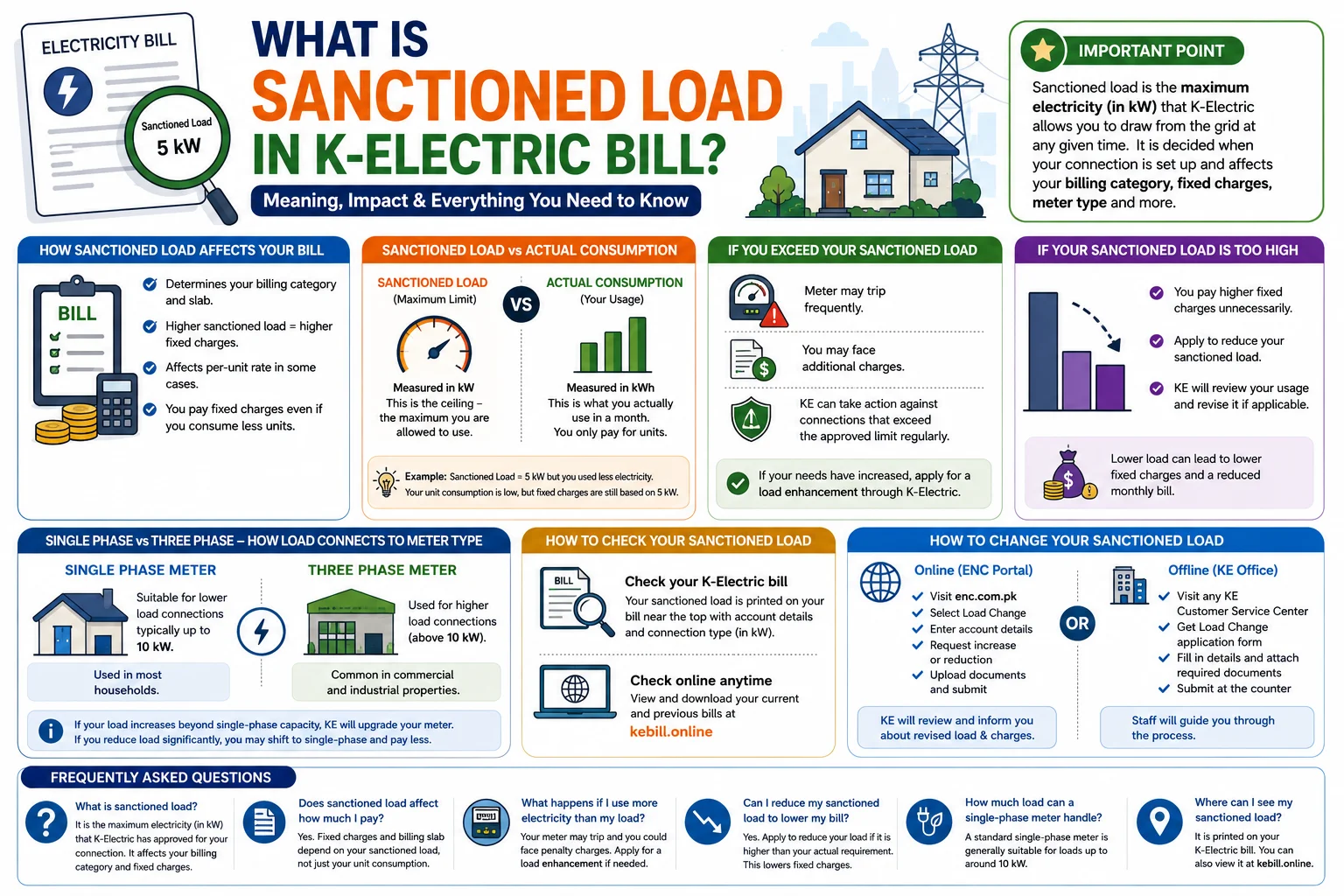
If you have ever looked closely at your K-Electric bill you have probably noticed a term called “Sanctioned Load” printed somewhere on it. Most people glance at it have no idea what it means and move on. But sanctioned load is actually one of the most important figures on your entire bill. It directly affects how much you pay every month what type of meter you have and what happens if you ever add more appliances to your home or office. This guide explains exactly what sanctioned load means how it works and why you should care about it.
What is Sanctioned Load in K-Electric Bill
Sanctioned load is the maximum amount of electricity measured in kilowatts (kW) that K-Electric officially allows you to draw from the grid at any given time. Think of it as a limit that was agreed upon when your electricity connection was first set up.
When someone applies for a new KE connection they tell K-Electric how much electricity they expect to use. Based on that information the size of the property the number of rooms the appliances being used and whether it is a home or a business K-Electric calculates an appropriate load limit and approves it. That approved figure becomes your sanctioned load and it stays on your account unless you formally request a change.
It is essentially a contract between you and K-Electric. You told them you need a certain amount of electricity they agreed to supply it and your meter and billing structure are both set up around that number.
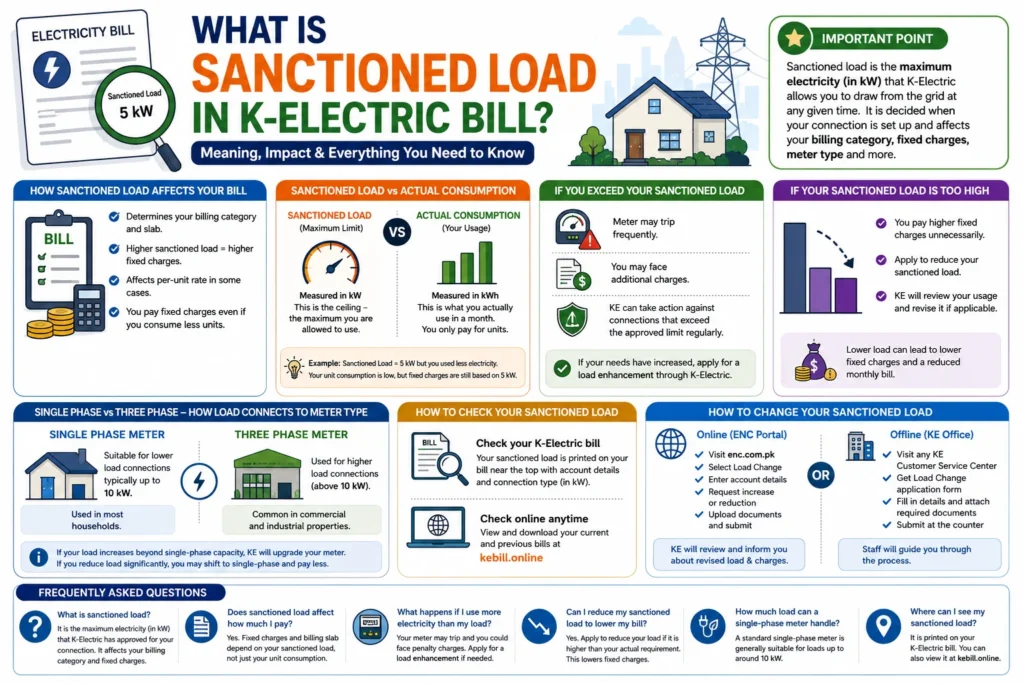
What is Sanctioned Load in K-Electric Bill
This is where most people get confused. Your monthly electricity bill is not just based on how many units you consumed. K-Electric uses your sanctioned load to determine your billing category your fixed charges and in some cases your per-unit rate.
In Pakistan’s electricity tariff structure customers are placed into different billing slabs based on their connection type and sanctioned load. A domestic customer with a lower sanctioned load pays differently than one with a higher load even if their actual consumption in units happens to be similar. This means your sanctioned load is quietly influencing your bill every single month whether you realize it or not.
There are also fixed charges on your bill that are directly tied to your sanctioned load. These are charges you pay regardless of how much electricity you actually use that month. A higher sanctioned load means higher fixed charges. So if your sanctioned load was set higher than what you actually need you are essentially paying extra every month for capacity you are not using.
Sanctioned Load vs Actual Consumption What is the Difference?
These two things are completely separate and people often mix them up.
Your sanctioned load is the ceiling the maximum you are allowed to use. Your actual consumption is how many units of electricity you actually used during the billing month measured in kilowatt-hours (kWh). You only pay for the units you actually consume but your sanctioned load still affects your fixed charges and billing category regardless of consumption.
To give a simple example imagine your sanctioned load is 5 kW but in a particular month you only used electricity for lighting and a fan. Your unit consumption will be very low but you will still be billed based on a 5 kW connection when it comes to fixed charges. This is why it is worth making sure your sanctioned load matches your actual needs as closely as possible.
What is Sanctioned Load in K-Electric Bill
If your actual electricity usage regularly pushes beyond your sanctioned load a few things can happen. Your meter may trip frequently because it is designed to handle only up to your approved limit. You may also face additional charges on your bill for exceeding the permitted load. In some cases K-Electric can take action against connections that are consistently drawing more power than their approved limit.
The right thing to do if your needs have grown you added an air conditioner expanded your business or built an extra floor is to formally apply for a load enhancement through K-Electric. This updates your sanctioned load to match your actual requirements and keeps everything above board.
What if Your Sanctioned Load is Too High?
This is actually a more common problem than people think. Many connections were set up years ago with a generous load estimate that no longer reflects actual usage. If your sanctioned load is higher than what you genuinely need you are paying higher fixed charges every month unnecessarily.
You can apply to K-Electric to reduce your sanctioned load. The process involves submitting a request through the ENC portal at enc.com.pk or visiting a KE Customer Service Center. K-Electric will review your usage history and if your actual consumption supports a lower load they will revise it. This can result in a meaningful reduction in your monthly bill going forward.
Single Phase vs Three Phase How Load Connects to Meter Type
Your sanctioned load also determines what type of meter you have. In genera a single-phase meter is suitable for lower load connections typically up to 10 kW and is the standard for most households. A three-phase meter is used for higher load connections and is more common in commercial properties large houses and industrial setups.
If your sanctioned load increases beyond what a single-phase meter can handle K-Electric will upgrade your meter to a three-phase connection. Similarly if you reduce your load significantly you may be able to move to a single-phase meter which typically comes with lower charges.
How to Check Your Sanctioned Load
The easiest way is to look at your K-Electric bill. Your sanctioned load is printed on the bill usually near the top along with your account details and connection type. It will be listed in kilowatts (kW).
You can also check your bill details online anytime at kebill.online where you can view and download your current and previous bills.
How to Change Your Sanctioned Load
Whether you want to increase or decrease your sanctioned load the process goes through K-Electric’s ENC portal at enc.com.pk. Select the load change option fill in your account details explain whether you want an increase or reduction and by how much and submit the required documents. A KE representative will assess your request and get back to you with the revised load and any associated costs.
If you prefer doing it in person visit any K-Electric Customer Service Center and ask for the load change application form. The staff will guide you through the process.
Frequently Asked Questions
Sanctioned load is the maximum electricity in kilowatts (kW) that K-Electric has officially approved for your connection. It is set when you first get a connection and affects your billing category and fixed charges every month.
Yes. Your fixed charges and billing category are based on your sanctioned load, not just your unit consumption. A higher sanctioned load means higher fixed charges even in months when you use very little electricity.
Your meter may trip and you could face penalty charges. If your needs have genuinely increased, the right step is to apply for a load enhancement through KE so your connection is updated officially.
Yes. If your current sanctioned load is higher than what you actually need, you can apply to reduce it. This can lower your fixed charges and reduce your overall monthly bill.
A standard single-phase meter is generally suitable for loads up to around 10 kW. Beyond that, a three-phase connection is typically required.
It is printed on your K-Electric bill. You can also view your bill details online at kebill.online.