
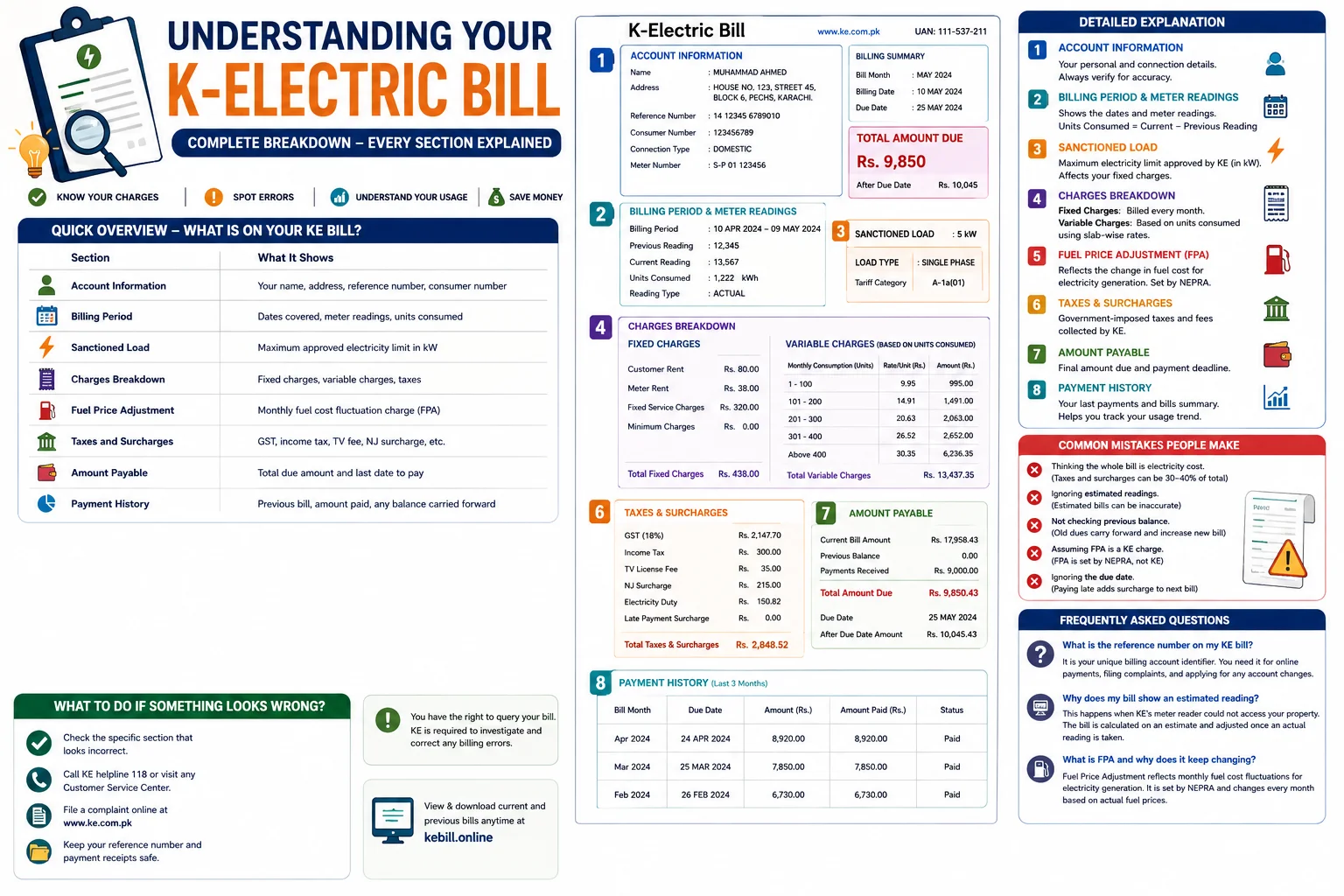
Most people in Karachi receive their K-Electric bill every month, glance at the total amount, and pay it without understanding anything else on it. That works fine until something goes wrong your bill suddenly doubles, you spot a charge you do not recognize, or you need to dispute something. At that point, not understanding your own electricity bill becomes a real problem.
The truth is that a K-Electric bill contains a lot of useful information and once you know what each section means, it becomes much easier to catch errors, understand why your bill is high, and make smarter decisions about your electricity usage. This guide breaks down every part of your KE bill in plain, simple language.
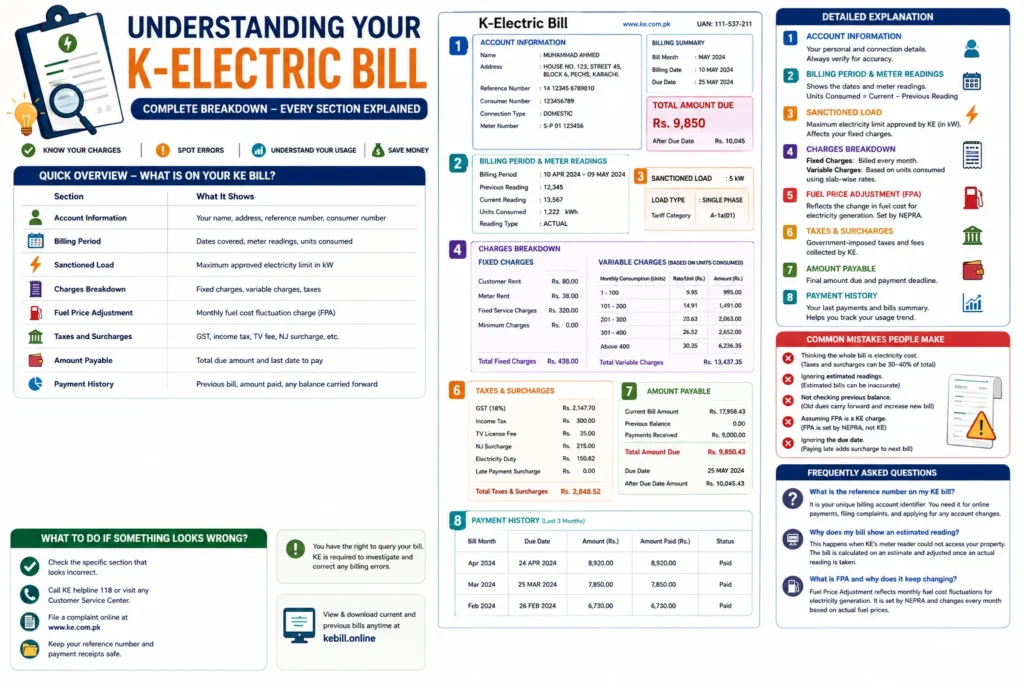
Quick Overview What is on Your KE Bill?
| Section | What It Shows |
| Account Information | Your name, address, reference number, consumer number |
| Billing Period | Dates covered, meter readings, units consumed |
| Sanctioned Load | Maximum approved electricity limit in kW |
| Charges Breakdown | Fixed charges, variable charges, taxes |
| Fuel Price Adjustment | Monthly fuel cost fluctuation charge |
| Taxes and Surcharges | GST, income tax, TV fee, NJ surcharge |
| Amount Payable | Total due amount and last date to pay |
| Payment History | Previous bill, amount paid, any balance carried forward |
Account Information Top Section of the Bill
The very top of your K-Electric bill is where all your basic account details are printed. Most people skip this entirely but it is worth checking at least once to make sure everything is correct.
| Field | What It Means |
| Name | The registered account holder’s name |
| Address | Your property address as registered with KE |
| Reference Number | Your unique billing ID needed for online payments and complaints |
| Consumer Number | Identifies your physical meter connection |
| Connection Type | Whether your account is domestic, commercial, industrial, or agricultural |
| Meter Number | The serial number of the meter installed at your property |
Your connection type is particularly important. Each category is billed at a completely different rate. If you are running a small business but still registered as domestic, or vice versa, you could be overpaying or underpaying both of which can cause problems eventually.
Billing Period and Meter Readings
This section tells you exactly which dates the bill covers and how your units were calculated.
| Field | What It Means |
| Billing Period | Start and end dates of this bill’s coverage |
| Previous Reading | Meter reading at the end of last month |
| Current Reading | Meter reading at the end of this month |
| Units Consumed | Difference between current and previous reading (in kWh) |
| Reading Type | Actual (meter was physically read) or Estimated (KE estimated your usage) |
The units consumed is simply current reading minus previous reading. This is the most straightforward number on your bill. If it looks unusually high compared to your normal usage, check whether the reading is actual or estimated estimated readings are sometimes inaccurate and worth querying.
If you keep getting estimated bills for several months in a row, contact KE and ask them to send someone for an actual meter reading.
Sanctioned Load
Your sanctioned load is printed on the bill in kilowatts (kW). This is the maximum electricity KE has officially approved for your connection. It was set when your connection was first established and it plays a bigger role in your bill than most people realize.
| Sanctioned Load | Typical Connection Type |
| Up to 5 kW | Small household, single phase |
| 5 kW to 10 kW | Medium household, single phase |
| 10 kW to 40 kW | Large house or small commercial, three phase |
| Above 40 kW | Industrial or large commercial |
Your sanctioned load affects your fixed charges every month regardless of how much electricity you actually use. If your sanctioned load is higher than what you genuinely need, you are paying more than necessary. You can apply to reduce it through the ENC portal at enc.com.pk
Charges Breakdown The Most Important Section
This is where your bill amount is actually calculated. It is broken into two main types of charges fixed charges and variable charges.
Fixed Charges
Fixed charges are billed every month no matter how much or how little electricity you use. They are based on your sanctioned load and connection type.
| Charge | What It Means |
| Meter Rent | Monthly fee for the meter installed at your property |
| Fixed Service Charges | A flat charge based on your sanctioned load |
| Minimum Charges | Applied if your unit consumption falls below a minimum threshold |
Variable Charges (Based on Units Consumed)
These charges depend entirely on how many units of electricity you used during the billing month. KE uses a slab system the more you consume, the higher your per-unit rate gets.
| Monthly Consumption | Rate Category |
| 1 – 100 units | Lowest rate (protected slab) |
| 101 – 200 units | Slightly higher rate |
| 201 – 300 units | Medium rate |
| 301 – 400 units | Higher rate |
| Above 400 units | Highest rate |
This is why your bill jumps so sharply in summer. When you switch on air conditioners, your consumption crosses into higher slabs and your per-unit rate increases alongside your usage a double effect that catches many people off guard.
Fuel Price Adjustment (FPA)
Fuel Price Adjustment, commonly written as FPA on your bill, is one of the most confusing charges for KE customers. It appears every month and the amount changes constantly, sometimes positive and sometimes negative.
FPA is a government-mandated charge that reflects the actual cost of fuel used to generate electricity in a given month. When fuel prices go up globally oil, gas, coal the cost of generating electricity increases and that increase is passed on to consumers through FPA. When fuel prices fall, you sometimes get a negative FPA which actually reduces your bill slightly.
This charge is not set by K-Electric. It is determined by NEPRA, Pakistan’s national electricity regulator, and KE is required to apply it. The FPA amount on your bill refers to a previous month’s fuel cost, not the current month, which is why it can appear inconsistent.
| FPA Type | What It Means for Your Bill |
| Positive FPA | Fuel costs were high your bill increases |
| Negative FPA | Fuel costs were lower your bill decreases slightly |
| Zero FPA | No adjustment applied that month |
Taxes and Surcharges
After your main electricity charges and FPA, several taxes and surcharges are added. These are government-imposed and KE collects them on the government’s behalf.
| Charge | What It Is |
| GST (General Sales Tax) | 18% tax applied on your electricity charges |
| Income Tax | Withheld if your bill exceeds a certain threshold |
| TV License Fee | A small annual fee collected for PTV |
| NJ Surcharge | Neelum Jhelum hydropower project surcharge |
| Electricity Duty | Provincial tax on electricity consumption |
| Late Payment Surcharge | Added if previous bill was not paid on time |
Many people are surprised by how much these taxes add to the final amount. In some cases taxes and surcharges can account for 30 to 40 percent of the total bill. These are not KE charges they are collected by KE and passed directly to the government.
Amount Payable Section
This is the section most people jump straight to. It shows you exactly how much you owe and when you need to pay it.
| Field | What It Means |
| Current Bill Amount | Total charges for this billing month |
| Previous Balance | Any amount carried forward from last month |
| Payments Received | What KE has recorded as received from you |
| Total Amount Due | Everything you owe right now |
| Due Date | Last date to pay without a late surcharge |
| After Due Date Amount | Higher amount if you pay after the due date |
Always check the previous balance and payments received fields. Occasionally a payment you made does not get recorded correctly on the system. If you paid your last bill but it still shows as outstanding, keep your payment receipt and contact KE to get it corrected.
Payment History
At the bottom of the bill you will usually find a short payment history showing your last few months of bills and payments. This is useful for spotting patterns if your bill has been steadily climbing over several months, this section makes it easy to see at a glance.
Common Mistakes People Make When Reading Their Bill
Most billing disputes and confusions come down to a few very common misunderstandings.
| Mistake | Reality |
| Thinking the whole bill is electricity cost | Taxes and surcharges can be 30-40% of total |
| Ignoring estimated readings | Estimated bills can be wrong always check |
| Not checking previous balance | Old dues carry forward and inflate new bills |
| Assuming FPA is a KE charge | FPA is set by NEPRA, not KE |
| Ignoring the due date | Paying late adds a surcharge to next month’s bill |
What to Do if Something Looks Wrong
If any figure on your bill does not make sense unusually high units, a charge you do not recognize, or a payment not showing up do not just pay and ignore it. You have the right to query your bill.
You can file a complaint through KE’s official website, call their helpline at 118, or visit any K-Electric Customer Service Center. When you contact them, have your reference number ready along with the specific section of the bill you want to query. KE is required to investigate billing complaints and correct any errors found.
You can also view and download your current and previous bills anytime at kebill.online useful for comparing months and spotting unusual changes.
Frequently Asked Questions
It is your unique billing account identifier. You need it for online payments, filing complaints, and applying for any account changes.
This happens when KE’s meter reader could not access your property. The bill is calculated on an estimate and adjusted once an actual reading is taken.
Fuel Price Adjustment reflects monthly fuel cost fluctuations for electricity generation. It is set by NEPRA and changes every month based on actual fuel prices.