
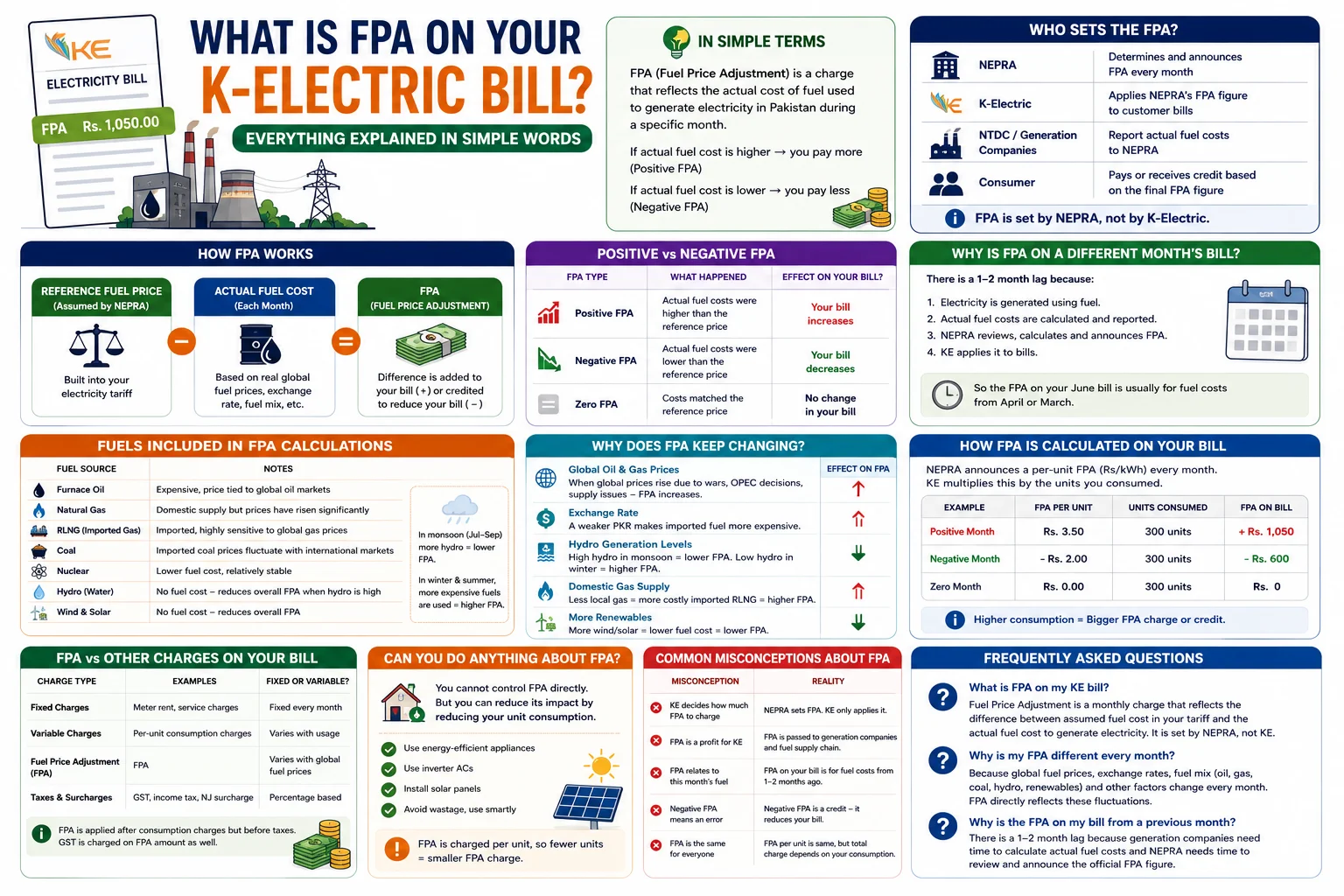
If you have ever looked at your K-Electric bill and wondered what that “FPA” charge is and why it keeps changing every month, you are not alone. Fuel Price Adjustment is one of the most misunderstood charges on any electricity bill in Pakistan. Some months it adds a significant amount to your bill. Other months it is negative and actually brings your total down. And most people have absolutely no idea why.
This guide explains exactly what Fuel Price Adjustment is, how it is calculated, why it fluctuates, and what it means for your monthly electricity bill in plain, simple language.
What is Fuel Price Adjustment?
Fuel Price Adjustment, commonly written as FPA on your KE bill, is a charge that reflects the actual cost of fuel used to generate electricity in Pakistan during a specific month. It is not a fixed charge it changes every single month based on how much fuel cost to generate electricity and how that cost compares to a baseline rate that was set in advance.
Here is the simple version. When NEPRA Pakistan’s National Electric Power Regulatory Authority sets electricity tariffs, they build in an assumed fuel cost per unit. That assumed cost is called the reference fuel price. In real life, fuel prices go up and down constantly based on global oil markets, gas supply, exchange rates, and dozens of other factors. When actual fuel costs turn out to be higher than what was assumed, the difference is charged to consumers as a positive FPA. When actual costs turn out lower, consumers get a negative FPA that reduces their bill.
Think of it as a monthly reconciliation between what was planned and what actually happened with fuel costs.
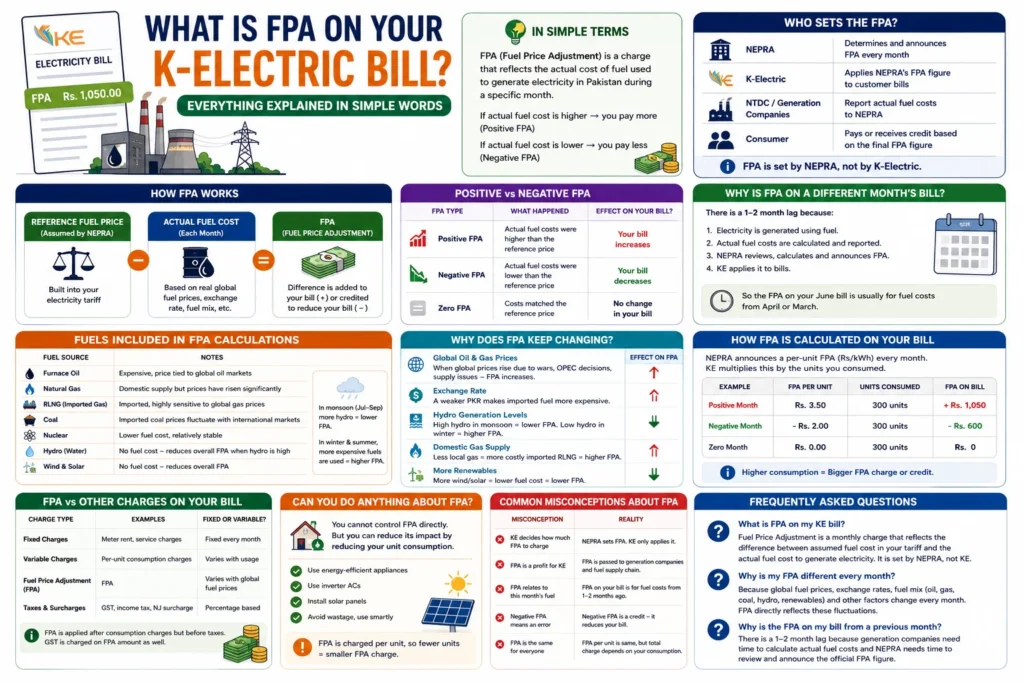
Who Sets the FPA?
This is the part most people do not know. FPA is not set by K-Electric. It is determined by NEPRA and is applied to electricity bills across Pakistan by all distribution companies including KE. K-Electric simply collects it on behalf of the system they have no control over the amount.
| Entity | Role |
| NEPRA | Determines and announces FPA every month |
| K-Electric | Applies NEPRA’s FPA figure to customer bills |
| NTDC / Generation Companies | Report actual fuel costs to NEPRA |
| Consumer | Pays or receives credit based on the final FPA figure |
This is an important distinction. When people complain to KE about FPA, KE cannot do anything about it because they did not set the charge. Any concern about FPA needs to go to NEPRA, which has a public complaint portal and holds regular public hearings on tariff matters.
Why Does FPA Appear on a Different Month’s Bill?
One of the most confusing things about FPA is the timing. The FPA charge on your current bill does not relate to this month’s fuel costs. It relates to fuel costs from one or two months ago.
This happens because of how the process works. Generation companies first generate electricity using fuel. They then calculate their actual fuel costs and report them. NEPRA reviews these figures, does its own calculations, determines the FPA amount per unit, and then notifies distribution companies to apply it. By the time all of this happens, one to two months have passed.
So when you see an FPA charge on your bill in June, it is most likely based on fuel costs from April or March. This delay is why FPA can feel random or disconnected from anything happening in the news right now.
Positive vs Negative FPA What Each One Means
| FPA Type | What Happened | Effect on Your Bill |
| Positive FPA | Actual fuel costs were higher than the reference price | Your bill increases |
| Negative FPA | Actual fuel costs were lower than the reference price | Your bill decreases |
| Zero FPA | Costs matched the reference price exactly | No change |
A negative FPA is actually good news for consumers. It means fuel was cheaper than expected that month and you are getting a credit that reduces what you owe. However many people see a negative number on their bill and panic thinking something is wrong it is not. It is a reduction in your favor.
What Fuels Are Included in FPA Calculations?
Pakistan generates electricity from several different fuel sources and each one has its own cost that feeds into the overall FPA calculation.
| Fuel Source | Notes |
| Furnace Oil | Expensive, price tied to global oil markets |
| Natural Gas | Domestic supply but prices have risen significantly |
| RLNG (Liquefied Natural Gas) | Imported, highly sensitive to global gas prices |
| Coal | Imported coal prices fluctuate with international markets |
| Nuclear | Lower fuel cost, relatively stable |
| Hydro (Water) | No fuel cost reduces overall FPA when hydro generation is high |
| Wind and Solar | No fuel cost similarly reduces FPA |
When expensive fuel sources like furnace oil and RLNG dominate electricity generation in a given month, FPA goes up sharply. When hydro generation is high typically in monsoon months from July to September the overall fuel cost per unit drops and FPA tends to be lower or even negative. This is one of the reasons electricity bills in Pakistan are often lower in monsoon months compared to winter and summer.
Why Does FPA Keep Changing So Much?
Several factors drive FPA fluctuations every month and most of them are connected to global events that are completely outside Pakistan’s control.
- Global Oil and Gas Prices Pakistan imports a significant portion of its fuel for electricity generation. When global crude oil prices rise due to wars, OPEC decisions, supply disruptions the cost of furnace oil and RLNG goes up immediately and FPA follows.
- Exchange Rate Since fuel is purchased in US dollars, a weaker Pakistani rupee means importing the same amount of fuel costs significantly more in rupee terms. When the rupee depreciates, FPA tends to increase even if the dollar price of fuel stays the same.
- Hydro Generation Levels During monsoon season when rivers are full, hydroelectric plants generate a larger share of Pakistan’s electricity at effectively zero fuel cost. This brings down the overall fuel cost per unit and reduces FPA. In dry winter months when hydro generation drops, more expensive thermal plants pick up the slack and FPA rises.
- Domestic Gas Supply Pakistan’s domestic gas fields have been declining in output for years. As gas supply decreases, generation companies have to use more expensive imported RLNG as a replacement, which pushes fuel costs and therefore FPA higher.
| Factor | Effect on FPA |
| Rising global oil prices | FPA increases |
| Weaker Pakistani rupee | FPA increases |
| High hydro generation (monsoon) | FPA decreases |
| More RLNG use | FPA increases |
| More renewable energy | FPA decreases |
| Falling global gas prices | FPA decreases |
How is FPA Calculated on Your Bill?
NEPRA announces a per-unit FPA figure each month. This figure is in rupees per kilowatt-hour (Rs/kWh). K-Electric then multiplies this figure by the number of units you consumed during the relevant billing period.
For example, if NEPRA announces an FPA of Rs 3.50 per unit and you consumed 300 units that month, your FPA charge would be Rs 1,050. If the FPA is negative at Rs 2.00 per unit and you consumed 300 units, your bill would be reduced by Rs 600.
| Example | FPA per Unit | Units Consumed | FPA on Bill |
| Positive month | Rs 3.50 | 300 units | + Rs 1,050 |
| Negative month | – Rs 2.00 | 300 units | – Rs 600 |
| Zero month | Rs 0 | 300 units | Rs 0 |
This is why high-consumption households feel the impact of FPA much more than low-consumption ones. The more units you use, the bigger the FPA charge or credit on your bill.
FPA vs Other Charges How It Fits Into Your Bill
It helps to understand where FPA sits within your overall bill structure.
| Charge Type | Examples | Fixed or Variable |
| Fixed Charges | Meter rent, service charges | Fixed every month |
| Variable Charges | Per-unit consumption charges | Varies with usage |
| Fuel Price Adjustment | FPA | Varies with global fuel prices |
| Taxes and Surcharges | GST, income tax, NJ surcharge | Percentage based |
FPA is applied after your basic consumption charges are calculated but before taxes. GST is then applied on top of the FPA amount as well, which means a higher FPA also slightly increases your tax bill.
Can You Do Anything About FPA?
Honestly, not much at least not directly. Since FPA is determined by global fuel markets and NEPRA policy, individual consumers cannot negotiate or avoid it. However there are indirect ways to reduce its impact.
The most effective approach is reducing your overall electricity consumption. Since FPA is charged per unit consumed, using fewer units means the FPA charge is smaller even when the per-unit FPA rate is high. Switching to energy-efficient appliances, using inverter air conditioners, installing solar panels, and being mindful of usage during peak hours all help lower your unit consumption and therefore reduce the total FPA you pay.
Solar panels in particular are increasingly popular in Karachi for this reason. Once you generate your own electricity, you consume fewer units from the grid and every charge that is calculated per unit including FPA shrinks accordingly.
Common Misconceptions About FPA
| Misconception | Reality |
| KE decides how much FPA to charge | NEPRA sets FPA KE only applies it |
| FPA is a profit for KE | FPA is passed directly to generation companies and the fuel supply chain |
| FPA relates to this month’s fuel | FPA on your current bill is for fuel costs from 1-2 months ago |
| Negative FPA means an error | Negative FPA is a credit it reduces your bill |
| FPA is the same for everyone | FPA per unit is the same but total charge depends on your consumption |
Frequently Asked Questions
Fuel Price Adjustment is a monthly charge that reflects the difference between the assumed fuel cost built into your tariff and the actual fuel cost incurred to generate electricity that month. It is set by NEPRA, not K-Electric.
Because global fuel prices, exchange rates, and the fuel mix used for electricity generation all change every month. FPA directly reflects these fluctuations.
There is a one to two month lag because generation companies need time to calculate actual fuel costs and NEPRA needs time to review and announce the official FPA figure.